

Welding Equipment Series: Industrial Robots in Welding (2)
Jul 17, 20263. Classification of Industrial Robots
3.1 Classification by Mechanical Structure (The Most Fundamental Classification Method)
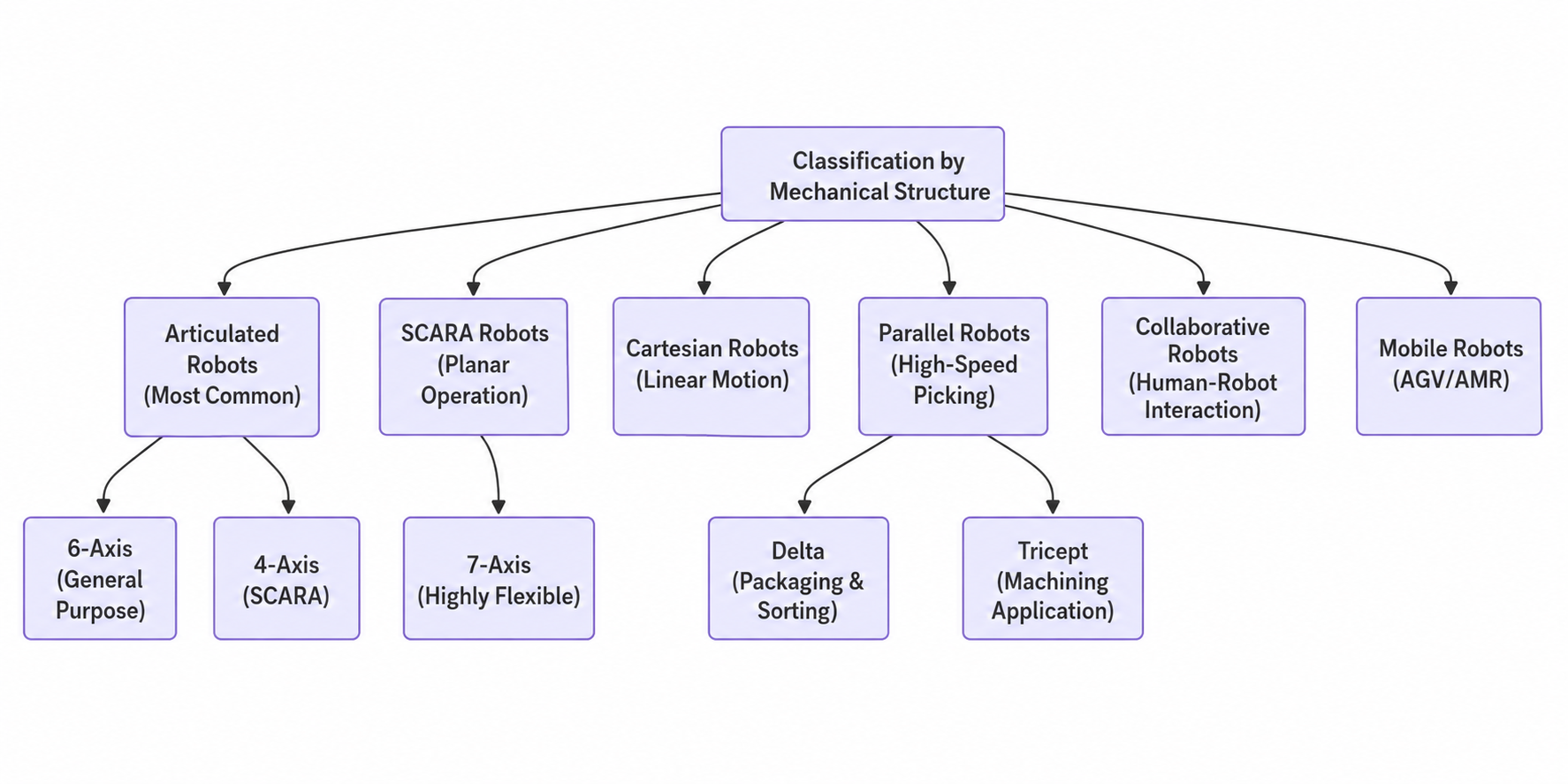
This classification is based on the robot's kinematic structure and mechanical design, which determine its workspace and primary application scenarios.
3.1.1 Articulated Robot
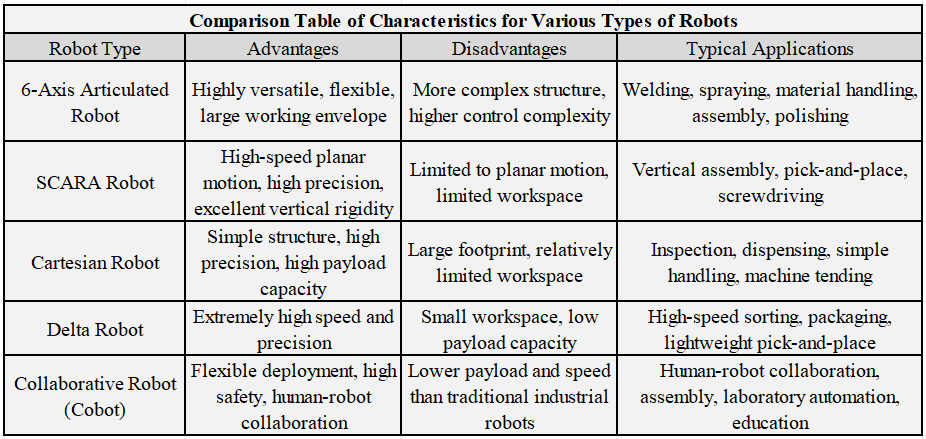
This is the most common and versatile type of industrial robot, designed to imitate the movement of the human arm.
Features: Consists of multiple rotary joints, typically with 4–6 axes (degrees of freedom), or even more (7-axis robots feature redundant degrees of freedom). It offers a large working envelope, excellent flexibility, and can easily reach almost any position within its workspace.
Typical Applications: Welding, painting, material handling, assembly, grinding, polishing, loading and unloading, and almost all industrial applications.
Subcategories:
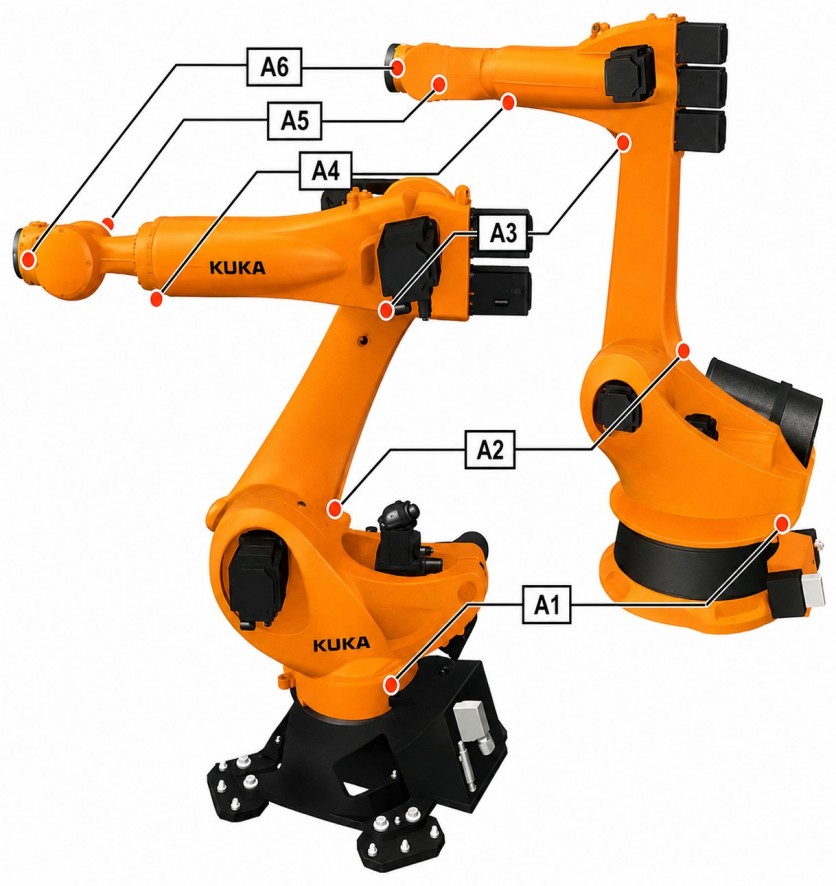
(1) 6-axis Robot: The most versatile configuration, capable of performing complex spatial movements.
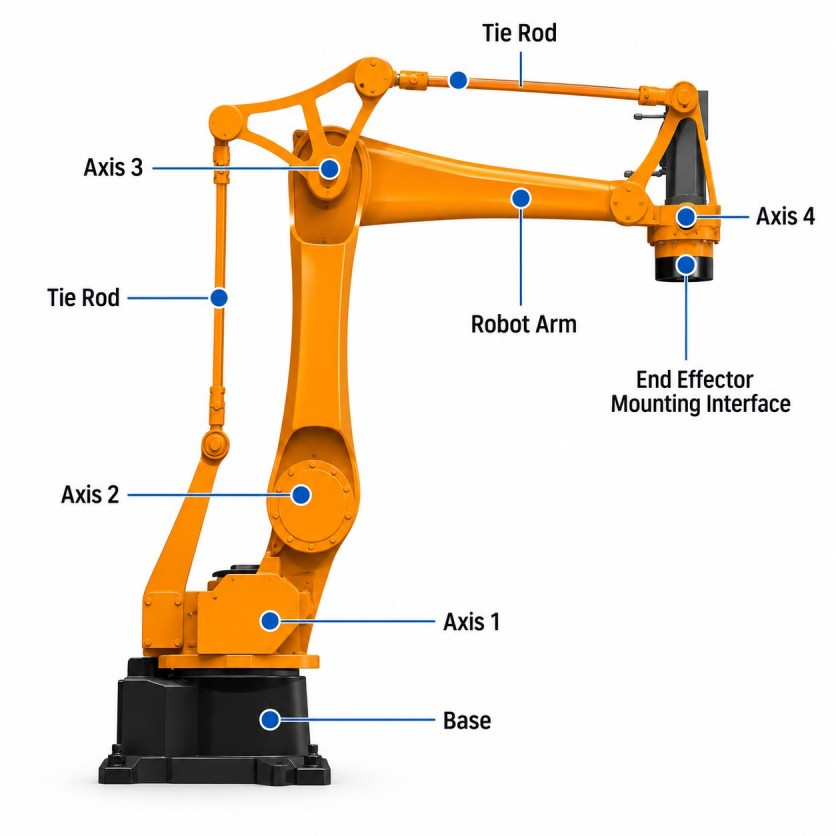
(2) 4-axis (Palletizing) Robot: Features a more robust structure and is specifically designed for high-speed, heavy-duty palletizing applications.
(3) 7-axis Robot: Includes an additional redundant axis, providing greater flexibility and allowing the robot to avoid obstacles more easily.
3.1.2 SCARA Robot (Selective Compliance Assembly Robot Arm)
Features: Equipped with three parallel rotary joints, providing excellent flexibility in horizontal movement, and one vertical linear axis, offering high rigidity in the vertical direction.
Typical Applications: Ideal for planar assembly, pick-and-place operations, material handling, screw fastening, and other precision tasks. Commonly used in the 3C electronics, semiconductor, and food packaging industries.
3.1.3 Cartesian Robot / Gantry Robot
Features: Composed of two or three linear axes (X, Y, and Z) arranged perpendicular to each other. It features a simple structure, intuitive programming, high accuracy, and strong payload capacity, although its workspace is relatively limited.
Typical Applications: CNC machine loading and unloading, inspection, material handling, gluing, dispensing, and simple assembly. Gantry-type Cartesian robots are also suitable for handling large workpieces.
3.1.4 Parallel Robot
Features: The moving platform (end effector) and fixed platform are connected by at least two independent kinematic chains using a parallel mechanism. It offers extremely high speed and precision but has a relatively small working area.
Typical Applications: High-speed sorting, packaging, and picking of lightweight products in industries such as food, pharmaceuticals, and cosmetics. The Delta robot is the most representative example.
3.1.5 Collaborative Robot (Cobot)
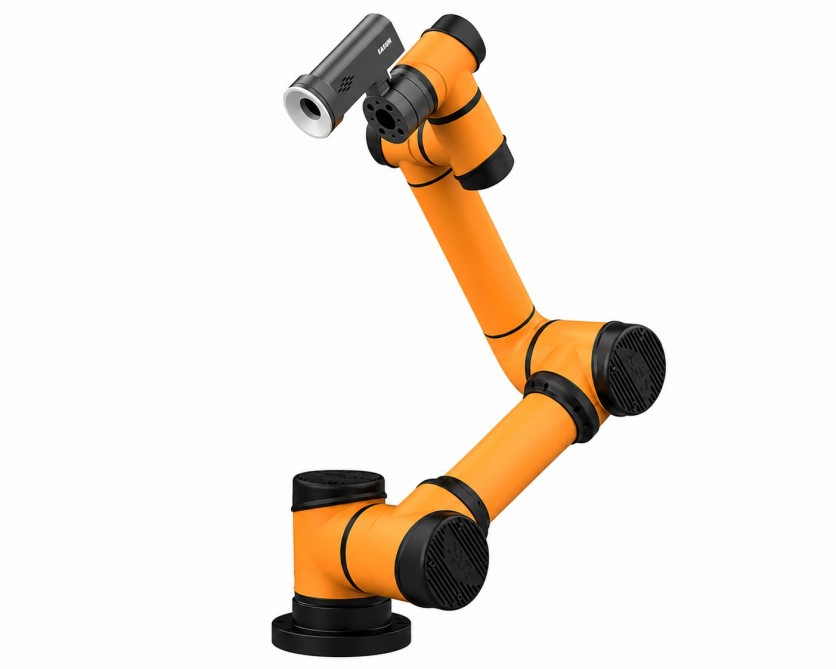
Features: This is not a structural classification but rather a functional and safety-oriented category. Collaborative robots can adopt any of the above mechanical structures (most commonly six-axis articulated robots) but are specifically designed to work safely alongside humans in a shared workspace. They typically feature force sensing, collision detection, lightweight construction, and rounded designs, eliminating the need for traditional safety fencing.
Typical Applications: Human-robot collaborative assembly, precision inspection, laboratory operations, and loading/unloading of small processing equipment.
3.1.6 Mobile Robot
Features: Combines a robotic arm with a mobile platform (AGV or AMR), enabling the robot to move freely and significantly expanding its operational range.
Typical Applications: Material handling, warehouse logistics, inspection, and service applications.
3.2 Classification by Application
Industrial robots can also be classified according to the specific tasks they are designed to perform.
3.2.1 Welding Robot
Includes spot welding robots (high payload capacity and rigidity) and arc welding robots (high path accuracy, usually equipped with weld seam tracking systems).
3.2.2 Painting Robot
Typically designed with explosion-proof protection and smooth motion trajectories to ensure uniform coating and prevent paint accumulation.
3.2.3 Handling/Palletizing Robot
Features a wide payload range, robust structure, and fast cycle times.
3.2.4 Assembly Robot
Offers high precision and typically adopts a SCARA structure or a compact six-axis robot.
3.2.5 Processing Robot
Includes robots for laser cutting, waterjet cutting, polishing, and grinding. These applications generally require high rigidity, precise path control, and integrated force-control sensors.
3.2.6 Cleanroom Robot
Designed for semiconductor, LCD panel, and medical manufacturing industries. Special materials and surface treatments are used to minimize particle generation.
3.2.7 Vacuum Robot
Designed for semiconductor manufacturing processes, where wafers are transferred inside vacuum chambers.
3.3 Classification by Control Technology
3.3.1 Traditional Teach Pendant Robot
Programmed using a handheld teach pendant for point and path teaching. Programming efficiency is relatively low and adaptability to production changes is limited.
3.3.2 Offline Programming Robot
Programs and simulations are completed in a virtual computer environment before being downloaded to the robot, eliminating production line downtime during programming.
3.3.3 Intelligent Adaptive Robot
Integrates machine vision (2D/3D), force sensors, and AI algorithms to perceive the environment, identify workpieces, automatically plan paths, and adjust process parameters (such as welding parameters and grinding force) in real time, enabling intelligent teach-free operation.
3.4 Classification by Drive System
3.4.1 Electric Drive
Currently the dominant drive system, using servo motors to provide precise control, fast response, and clean operation.
3.4.2 Hydraulic Drive
Widely used in early industrial robots. It provides high power output but suffers from oil leakage, high noise, and relatively low control accuracy. Today, it is mainly used in ultra-heavy-duty applications.
3.4.3 Pneumatic Drive
Features a simple structure, low cost, and high operating speed. However, due to its limited control accuracy, it is mainly used for simple point-to-point operations or as an auxiliary actuator.
3.5 Classification by Performance
3.5.1 Heavy-Duty Robot
Offers payload capacities ranging from several hundred kilograms to several tons, making it suitable for automotive, aerospace, and heavy manufacturing industries.
3.5.2 High-Speed Robot
Designed for maximum motion speed and short cycle times. Typical examples include Delta robots and SCARA robots.
3.5.3 High-Precision Robot
Provides repeatability at the micron level, making it suitable for precision assembly, machining, and inspection applications.
¿Como podemos ayudarte?

Pes láser, proveedor de soluciones de equipos láser profesional


 Red IPv6 admitida